Heatwaves, cold snaps, tornadoes, earthquakes, are you hearing these terms in the news more often, or have personally experienced an impactful weather event? In 2025, Alberta alone faced some serious weather events that disrupted communities, forced evacuations, ravaged infrastructures, and left people without power.
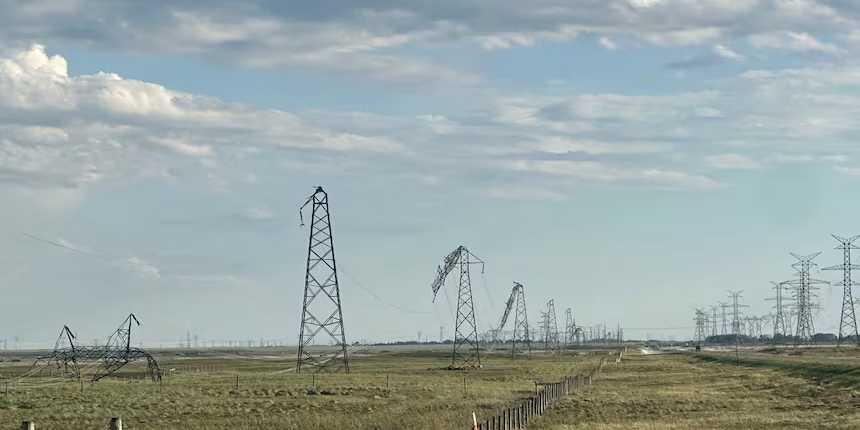
The power system is not immune from the threats of extreme weather events. In January and April 2024, Alberta’s electric system was challenged by sustained extreme cold, causing supply shortfalls, even resulting in the first firm load shed in the province since 2013. In May 2025, an out-of-control wildfire in Northeastern Alberta burned down structures and prompted a temporary power shut-off to safeguard assets and communities. Just a few months later, in August, a powerful storm swept through Southern Alberta, toppling dozens of poles and wires before making its way into Saskatchewan.
As extreme weather events (EWEs) become more frequent and intense, one critical question emerges: How can we define EWEs in a way that informs power system planning and operation, enabling a grid that is resilient against nature’s challenges?
Climate science and engineering communities commonly define EWEs by specifying the attributes of EWEs, often focusing on their intensity, duration, and frequency. The table below highlights a few options.
| Method | Description | Pros (+) and Cons (-) | Example |
| Order statistics based | Selecting the top N events based on specific criteria. An example is the 10 warmest days in a given year. | + Easy to communicate. – May represent drastically different physical conditions across regions and time periods, making comparisons difficult. – Convey no information about distribution of attributes; a rank 1 event is more severe than rank 2, but it is not clear by how much. | • Development of NERC TPL-008, Transmission System Planning Performance Requirements for Extreme Temperature Events, established a set of ranked severe temperature scenarios as benchmark events for various jurisdictions [1] • ISO New England ranked and selected extreme events for energy-security risk assessment using their Probabilistic Energy Adequacy Tool (PEAT) [2] |
| Return period based | Return periods are developed using historical data over an extended period and represent the estimated average time between events of a certain magnitude. An example is a 100-year flood, (also known as 1-in-100 year or 1% flood) | + Widely used in engineering design and infrastructure planning, often embedded in standards and codes. + Comparable across jurisdictions – Commonly misunderstood by the public – Sensitive to data availability and quality – Does not account for non-stationary climate (i.e., a 100-year event in the past may become a 50-year event in the future) | • Alberta’s ISO Rules 503.22 Bulk Transmission Line Technical Requirements specified the minimum weather loading return to be used for bulk transmission lines [3] |
| Threshold based | These can be fixed or relative thresholds, often using one or more event attribute(s). Examples include events with wind speed > 120 km/h, or cold temperatures below the 1st percentile. | + Easy to implement – Fixed threshold does not account for non-stationary climate, and are difficult to compare across regions, where different thresholds may be used. + Relative thresholds work well for changing (non-stationary) climate and allow easy comparison across regions. – Relative thresholds are sensitive to baseline selection, and require more statistical analysis | • Government of Canada defines heat waves using fixed thresholds: daily temperatures must reach heat warning thresholds (HWT) for two or more consecutive days with no relief overnight. HWTs differ by region, for example, Northern/Central Alberta uses a daytime max of 29°C, whilst Southern Alberta uses 32°C [4] • The Expert Team on Climate Change Detection and Indices (ETCCDI)’s Warm Spell Duration Index (WSDI) uses relative threshold, by counting the annual number of days with at least six consecutive days where daily max temperature exceeds the 90th percentile [5] |
There are many other ways to define EWEs, for example, Doble Engineering’s president offered a straightforward perspective in an interview: “[EWEs], by my definition are, the grid has gone down in some way, shape, or form.” [6] This approach is helpful when meteorological extremes and power system extremes do not align; in some cases, a minor meteorological event can cause extreme events for power systems that are already under stress. This method pragmatically defines EWEs simply by their impact on the power system. On the other end of the spectrum, more complex definitions are used for compounded EWEs, such as concurrent high winds and heavy precipitation events.
Which method should you choose? It depends on your goals and application. Start by considering which weather events are most critical for your system, and on what time scales. For example:
- Assessing or categorizing weather-related outages? Ranking approach works well for prioritizing events by their impact and consequence.
- Creating engineering requirements? Return periods and level provide clear limits for adherence.
- Evaluating resilience or supply risk? A percentile-based threshold is comparable across regions and can maintain its relevance over time.
The way you define EWEs can shape your entire approach to resilience—so choose wisely to maximize clarity and impact.
EMTPY ROW
References
[1] North American Electric Reliability Corporation (NERC), “ERO Enterprise Process for TPL-008-1 Benchmark Weather Event Development and Maintenance,” Standards Development and Engineering Process Document, Dec. 2024. [Online]. Available: https://www.nerc.com/globalassets/standards/projects/2023-07/tpl-008-1-ero-benchmark-weather-event-development-and-maintenance-process-final-updated.pdf
[2] ISO New England, “Operational Impact of Extreme Weather Events: Final Report on the PEAT Framework and 2027/2032 Study Results,” Dec. 2023. [Online]. Available: https://www.iso-ne.com/static-assets/documents/100006/operational_impact_of_exteme_weather_events_final_report.pdf
[3] Alberta Electric System Operator (AESO), “ISO Rules Section 503.22 – Bulk Transmission Line Technical Requirements,” [Online]. Available:https://www.aeso.ca/rules-standards-and-tariff/iso-rules/section-503-22-bulk-transmission-line-technical-requirements
[4] Environment and Climate Change Canada, “Extreme heat events temperature thresholds,” [Online]. Available: https://www.canada.ca/en/environment-climate-change/services/environmental-indicators/extreme-heat-events.html#annex-b
[5] Expert Team on Climate Change Detection and Indices (ETCCDI), “Definitions of the 27 Core Climate Change Indices,” [Online]. Available: https://etccdi.pacificclimate.org/list_27_indices.shtml
[6] CBS Boston, How extreme weather events impact the power grid, YouTube, Jun. 27, 2025. [Online]. Available: https://www.youtube.com/watch?v=q2Dhw_GMFI8
Note: the featured image shows damaged transmission towers and lines in Southeastern Alberta from a storm in 2025. The photo was sourced from CBC News, originally submitted by Dennis Van Nieuwkerk. Available: https://www.cbc.ca/news/canada/calgary/severe-storm-hail-brooks-1.7614356