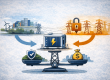

Wildfire smoke is no longer just an air-quality concern; it’s becoming a real operational factor for modern electric grids. As photovoltaic (PV) systems continue to integrate into distribution networks, feeder performance becomes increasingly dependent on weather and environmental conditions. Under clear skies, PV panels inject substantial power into the grid and reshape how voltages behave throughout the day. But during smoke events, sunlight can drop dramatically, cutting PV output and creating system conditions that traditional voltage-management tools were never designed to handle. Understanding how smoke interacts with high PV penetration is becoming essential for utilities planning for wildfire-season resilience.
Voltage Behavior Under High PV Penetration and Wildfire Smoke
In feeders with a large amount of solar generation, voltage patterns appear significantly different from those utilities have traditionally managed. On a typical clear day, PV systems push voltage upward along the feeder, often creating a midday peak not at the substation, but at locations where PV installations are clustered. This distributed injection can lead to voltage rise, reverse power flow, or sudden voltage fluctuations throughout the day. Local generation can help reduce current flowing from the substation and, in some cases, improve minimum voltage levels. But whenever PV output and local demand don’t align, a low-voltage condition can still develop. The result is a voltage profile that is far from the smooth, predictable decline utilities expect; it becomes irregular, rising and falling depending on where generation and loads sit along the feeder.
Wildfire smoke adds a new layer of complexity. Because smoke scatters and absorbs sunlight, it cuts the amount of irradiance that reaches PV modules. When this happens, the midday voltage rise that typically accompanies strong solar output becomes muted or, in heavier smoke events, almost disappears. Feeders that usually experience high midday voltages may instead operate closer to their morning or evening voltage levels. This reduced generation increases the likelihood of undervoltage, particularly at feeder extremities. In prolonged smoke events, systems that usually struggle with overvoltage may suddenly face the opposite problem. Even though the overall voltage range may narrow, the pattern becomes more erratic, influenced by changes in smoke density from hour to hour. These dynamics underscore the need for voltage-control strategies that can respond quickly to real-time conditions.
Operational Challenges for Utilities
The combination of reduced PV output and rapid fluctuations in irradiance creates several practical challenges for utilities. Legacy voltage-regulation equipment, such as tap changers, voltage regulators, and capacitor banks, was built for slow, predictable load changes, not the fast PV swings caused by shifting smoke plumes. Smoke events can trigger far more frequent operations of these devices, accelerate wear and tear, and increase maintenance needs.
Protection coordination becomes more complicated as well. Power flow may change direction multiple times a day, and fault-current levels may shift as PV output ramps up or down unexpectedly. These conditions make it harder for utilities to maintain proper protection settings without risking false operations.
Another significant barrier is visibility. Many distribution feeders still lack granular, real-time monitoring. Without sensors at key locations, operators may struggle to determine whether a voltage anomaly is local or affecting the entire feeder. Because smoke can linger for days or even weeks, these operational stresses aren’t short-term; they demand sustained attention.
Altogether, these challenges underscore the growing importance of enhanced monitoring, smoke-aware PV forecasting tools, and more intelligent inverter-based voltage control to maintain grid stability when visibility and generation are compromised.
Conclusion
As solar adoption continues to grow, voltage instability during wildfire-smoke events is becoming an increasingly important issue for distribution networks, especially in regions prone to seasonal wildfires. Understanding how smoke alters PV behavior and how these changes interact with aging infrastructure is essential for designing resilient and adaptable grids. Continued improvements in forecasting, modeling, and adaptive voltage control will play a crucial role in ensuring grid reliability under smoky conditions.
Interested in exploring further discussions? Contact Ala’a on LinkedIn.